Changes II – 2006

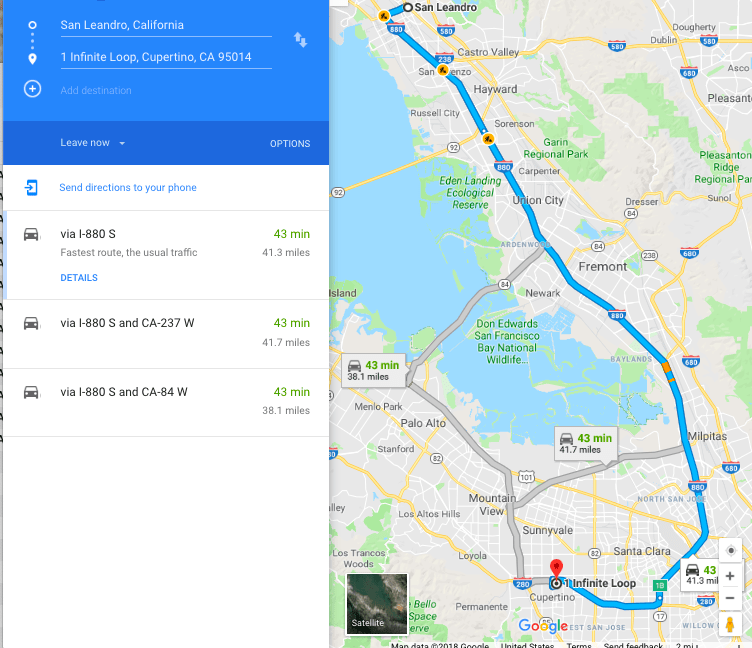
My first child was born in 2005. At the time, my career at Apple was starting to take off. But we lived at least an hour from Apple in San Leandro. The commute was really painful now that we had a baby in daycare and both of us had full-time jobs. If something happened to my spouse, and I had to pick up the baby, I basically had to leave at 2:30 when I normally would leave at 5:30 or 6:00. I was basically gone from 9:00 AM to 8:00 PM. It was really hard on my spouse and the baby.
Screen Shot 2018-10-30 at 00.07.13
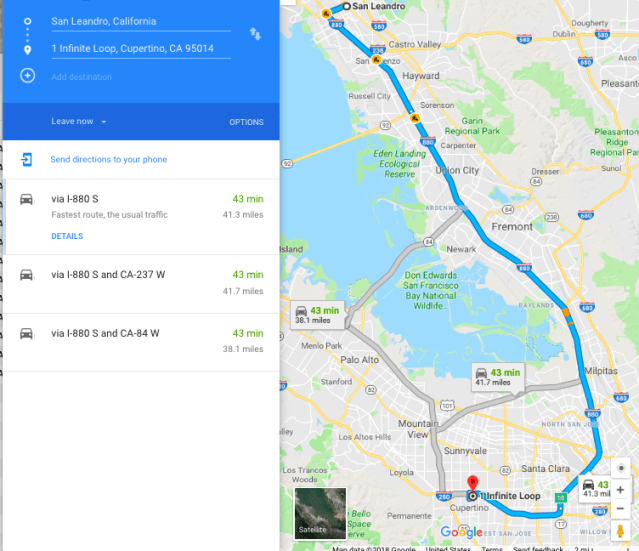
Actually, taking 880 to 92 to 280 was longer, but rarely had traffic in the morning, so it took less time. And it was a beautiful drive, with views of San Francisco, and hills. The evening commute was always terrible, though.

And the work was ramping up as my responsibilities grew.

And then we got pregnant again.

Funny thing about having children: you look at the world differently. We loved our house in San Leandro, and our little neighborhood subdivision was really nice and pretty. However, it was really close to really bad neighborhoods in San Leandro, Oakland, San Lorenzo, and Hayward. Now that we had children, we saw many more shady characters walking and driving around. The high school up the road was truly scary-looking. We decided that we needed alternatives to San Leandro.

There was the night we were up with the baby, and a couple of men were parked in an old car with the engine running right outside our house, talking for two or three hours.

And there was the time the intersection where we lived had tire-mark donuts in it, from somebody doing “sideshow” driving.

We started looking at houses closer to Apple, which would improve my commute, and put us in much better school districts. My wife’s work required a lot of travel, and our house was close to the Oakland Airport. San Jose International had a different, less convenient set of flights, so that would be a drawback, but not that bad, considering the other benefits.

We started taking a look at real estate in Cupertino, Sunnyvale, Santa Clara, Mountain View, Los Altos, and Palo Alto. And we were horrified. Our house in San Leandro was a 4000 square feet, 4 bedroom, 3.5 bath Spanish-style house, with a big kitchen and good living spaces. There was no yard or anything, but the house was spectacular.

There were no houses like that on the Peninsula or in South Bay.

We spent many weekends looking at houses. We found 50 year old houses that hadn’t been updated for $800,000. We found some smallish new construction houses for $1.2 million. But the most dismaying was in Palo Alto.

It was a lot on University Avenue (a busy street). The lot had 4 tiny little houses on it, and one of them was for sale. It was 650 square feet, and had a bedroom, and bathroom, and a kitchen. The house hadn’t been updated (ever), and the roof had grass growing out of it. All of this could have been ours for a bargain price of $999,995! What a deal!

We did find a nice 3000 square-foot house in Cupertino was 3 bedrooms and 2.5 baths, and a reasonable yard. Relatively new. Still not as nice as the San Leandro house, but we liked it. It was $2.6 million.

A side note: I know that prices are much worse now 12 years later. It was still unbelievable then

We talked to our mortgage broker, and she said that she could get us into that house, but unless we made extra payments to the principal, we would not gain any equity unless interest rates went down, and if the housing market started losing value, or if interest rates went up, we would have a negative equity situation, and a ballooning monthly payment.

I grew up in Texas. I met my wife in Texas, even though she did not grow up there. Her ex-husband’s family was from Texas, and she had spent a lot of time there. My family was in Texas. Hers was in Kentucky, but Texas is a lot closer to Kentucky than California is.

I opened a web browser and started looking at positions. There were a lot of positions open in Dallas and Austin. Neither one of us were interested in Dallas, but Austin seemed intriguing.

After we discussed all of the options, we decided that I would pursue positions in Austin. I will discuss the job hunt and the position I eventually interviewed for and took in the next post, but one little post-script.

After I had an offer from the Austin firm, I was trying to plan my exit from Apple. One day, one of the engineers who had worked on the Intel transition approached me, and said, “I was impressed with your work during the Intel transition while in the Developer Tools Program Office.”

“Thanks.”

“There is a position in the Mac OS X Program Office I think you would be a great fit for. You should apply. It’s kind of like what you are doing now, but will be more strategic for Apple, have more visibility, and more impact.”

Sigh.

I told him, “Well, I am moving my family to Texas and leaving Apple. So I won’t be applying.”

He looked very disappointed. I wonder now if that was a position working with iPhone.


Changes, Part I – 2005

Apple was and is a great place. I had a rough patch (previously detailed here), but I was hitting my stride. I no longer felt I needed to leave in order to advance my career. I was a manager of a small QA team, and in charge of some crucial, but not code-based, content in the Developer Tools space.

One day, my boss pulled me into a room, and told me that I was being asked to join a secret project. They could not tell me anything about it; I had to sign the non-disclosure form to continue. The upside was working on something potentially important and strategic; the downside was I had to get permission to buy and sell Apple stock (and I might be turned down depending on what was going on). Also, I couldn’t tell anybody what the secret was.

I can tell it now because it became public. Apple was moving from Power PC G4 (produced by Motorola) to the Power PC G5 (produced by IBM) for desktops, potentially moving laptops as well. This actually did not affect my day-to-day work terribly much; the compiler, debugger, and Xcode teams were directly affected. But, in my role coordinating everything, I had to know.

Apple announced this at a World Wide Developer’s Conference, the annual pilgrimage of all of the developers to hear what Apple (and Steve Jobs) had to say about the state of the world.

Alas, it did leak; Apple accidentally published a premature version of the online store catalog (here is one article on geek.com talking about it). And one publication, and I can’t find the article, talked about the whole deal the Friday before.

My favorite is Steve Jobs at the announcement:

“I am here to tell you right now, that is was a mistake, and it’s true.”

It was big and powerful and fast, and one of my favorite Macs for the time it was released that I have ever owned.

A little while after the G5 was released (1-2 years later?), I was once again summoned to conference room by my boss, and asked to sign a piece of paper.

This was when I was brought into the big Intel secret.

My speculation is that the reason the Apple board agreed to buy NeXT was that Jobs promised he could deliver an Intel-based OS that could power Macs. After all, NeXTStep ran on a variety of hardware platforms by that point. I have no evidence of this, but it just makes sense.

When I got there, there was a team who was known to be working on Intel stuff, but they were in a badge-only set of offices, and we could not see the work they were doing. We were building Mac OS X for both Power PC, and Intel Xcode x86 architectures, although none of us could run the Intel versions of anything.

Sometime after I joined Apple in 2002, this article about the secret Intel project was published. This was a big deal. This leak caused more internally visible scrambling that anything else I saw when I was there. A few days after this article was published, Apple announced to its employees that Project Marklar was being shut down, and the engineers were being reassigned to work elsewhere. So, that was that, then.

We were still building Intel binaries in the build train, however. Every once in a while I asked about that, and was told to shut up and just accept it, despite the fact it really slowed down our builds, and caused problems for some of our compiler and build system features.

A while later, the former core Marklar team was made available to the Developer Tools team to help with the hard work of moving Mac OS X to code built on a new compiler. This is work I had done for Jaguar and Panther. Somebody else was doing the work for Tiger, but that person could certainly use the help of a handful of senior engineers.

After I signed the paper, I was informed that Marklar had not actually been shut down; the team now helping with compiler porting had been working on it the entire time, and they were helping with the compiler because it was the first compiler capable of building everything for an Intel release.

It was really cloak-and-dagger stuff. If I needed to talk to somebody about my work, I had to ask my boss, who had to ask her boss. If the person was already disclosed, it took a few minutes, and I would be in touch. If, however, the person was not disclosed, I had to make a case as to why they needed to be. If management agreed, I would get a phone call some time later from a very shocked person, and I would have to bring them up to speed.

One afternoon, my boss came by my cube, and asked if I could stay late. I asked how late, and she said that I would be out of here by 9:00. Meet her in the lobby of Infinite Loop 1 at 8:00 PM. And bring the cart from the lab.

At 8:00, outside of Building 1, there were about 20-25 people all nervously chatting and talking. Some of them had carts as well.

A rental moving truck drove up, and one of the program managers got out of the driver’s seat. She was laughing and happy. She had us line up behind the truck. When she opened the back, there were several dozen old G5 computer boxes. She started passing them out. Developer Tools got 10. She told us that these were the Intel developer prototype machines. They looked just like G5 towers, so they could be visible. But they had to be behind locked doors. As I was loading our machines onto the cart, my boss informed me that I was moving to an office with a door. The program manager also told us that she went to pick them up at a warehouse that Apple had not used for a while. Apparently, Steve Jobs, some of his staff, and some of the most senior managers had built these machines, with sixties music blaring on a stereo, and food and beer. She said these people were acting 20 years younger as they put these things together. There were even soldering irons in use! These things were very expensive computers, that’s for sure.

Right before WWDC 2005, my first child was born. I took a few hours out of my parental leave, and attended the keynote at Moscone West. Well, I was shuffled into the Apple employee viewing room, anyway; you had to be pretty special to be in the hall mostly reserved for paying developers.

And we watched the announcement. It was probably the proudest moment of my career as people who I worked with every day realized I had been working on this transition in plain sight.

Flock – 2005

Flock_icon
By Source, Fair use, https://en.wikipedia.org/w/index.php?curid=16480620. Because this attribution is leagally required.

Late in 2005, a recruiter called me. He was representing Flock, a social browser. They were past just starting out. They had a few engineers, a president, and not much else, and were looking for a VP of Engineering. They were at the point where they needed adult supervision. Would I be interested?

Well, I thought to myself, a startup could be quite lucrative, which would be great for my expanding family. It would take all spare time, which would not. However, with a title like VP, maybe the stock options would be generous?

From the recruiter:

The Culture

The Company’s goal is to attract motivated people who seek career opportunities with the industry leader, a growing company, whose products are superior to the competition and is dedicated to excellence.  The Company takes great pride in its people, and realizes they are its greatest resource; the desire is to make the environment one of opportunity for personal and career growth.  Like most start-ups, our work environment is fast-paced, collaborative, demanding, and highly productive. We all readily take on responsibilities outside our job descriptions and are all focused on getting a lot done. We value intelligence, flexibility, energy, perseverance, resourcefulness, commitment, willingness to learn, and ability to work at any level of detail and scope. Excellent oral and written communication skills are required, as well as good inter-personal skills. Accurate estimates of identified tasks, and the capacity to work under pressure are all a must.

Intangible Qualities they are looking for

They need an executive that is excellent with customers, respectful, cares about people, strong integrity & ethics, Someone that has a record of over-achievement success, & strong performer.  They are looking for an executive that prides themselves on long term career opportunities and personal growth ability.

This company is very much a “people” person company and that is the key driver with everyone they hire.  What they are looking for is a team builder, strategic thinker, bold, energetic, dynamic, change agent, someone that can partner with other executives, expand international markets, “eye of the tiger”, very sharp, articulate, brilliant, smart, &, charismatic, sense of humor, and self starter.

So, I decide to check it out. They sent me a white paper-like doc, and it starts with the following:

Flock is a new browser, built on top of firefox (sic). It is a functional browser with excellent features (including firefox features like tabbed browsing, etc.). What really makes is stand out are two additional features they’ve added to build social networking directly into the browsing experience: social bookmarking and a wysiwyg (sic) blog writing tool.

It then proceeds to describe the various features, referencing del.icio.us-type features. And it talks about its builtin blog editor. All somewhat interesting. So I agreed to stop by.

They were located in downtown Palo Alto in an old Victorian-era house, apparently owned by the venture capital firm backing them. The place as a house was sorely lacking; there was dry-rot, and it needed cleaning and painting. I walked in the front door, and was immediately assaulted by what I can only describe as Startup Funk. Took me back to StyleWare. It had elements of mildew, unclean bathrooms, unbathed young men, and stale Chinese food. The main room had 2 or 3 banquet tables covered with computers. The president’s office was a room off of the main room, and it was pretty nice.

We talked for half an hour about software management, scheduling, QA, demos, hiring, etc.; all of the stuff you would expect to talk about in a management interview. Then it was my turn to ask questions. So I asked the one that had been on my mind ever since the recruiter contacted me.

“How are you going to make money?”

“Well, we are working on our second round of funding.”

“No, what’s your revenue model?”

“The browser is free”

I paused, trying to be nice. I continued, “At some point, somebody who is not buying a stake in the company is going to have to pay you for something. It could be a cost to download, a cost for a subscription, or by selling ads somewhere. What’s your plan?”

“Oh, we aren’t worried about that right now. Our goal is to grow as fast as possible. At that point, it should be apparent how we generate revenue. Or we will be acquired.”

A couple of days later, I told them I wasn’t interested. This tech wasn’t interesting enough to work on without a business plan.

A few months later, I was in downtown Mountain View by the train station, and saw an office with their name on it, and movers moving stuff into it. At the time, I guessed that they had secured another round of funding.

However, they did not ever figure it out. They were acquired by Zynga in 2011, and the brower is no longer supported.

I never got to ask them how they were going to handle Firefox updates…

Tivo – 2004

tivo
These were cool devices once upon a time.


Got contacted by a recruiter about a manager position at Tivo. It would be managing an internal tools group.

Went to the interview. It went really well. I talked to 4 people, and we discussed compilers, debuggers, linux distributions, and how they were built and tested. How the open source community worked, and Tivo’s interaction with it.

We discussed personnel issues and performance reviews, and philosophies about hiring. I thought it was a great day of interviewing.

Then we got to the close. They asked me to sign something authorizing background checks (OK). And then they asked for a drug test, and gave me a list of approved labs.

I have never partaken of any illegal drug in my entire life. But that’s not the point.

I asked them why they cared. They told me that they really wanted reliable people that they could count on. I asked them if the background check included a police check. They said yes. I gave them my opinion that the police check should be good enough. They still said that the drug test was necessary.

I told them that if there was a false positive, and somebody told the health insurance provider, they could drop me from the health insurance, even if it was company provided. They tried to assure me that the false positive rate was very low.

I told them that I was not willing to submit to a drug test unless they had some legal reason, such as the handling of classified material, and if that were true, I would need a formal security clearance. I was certainly willing to do whatever it took if that were true. They told me that the security clearance was not necessary.

So I told them, “I’m not doing it. If that disqualifies me from this position, so be it,” and walked out.

The recruiter called me the next day, and said that they were willing to make me a generous offer if I would submit to the drug test. I told him no.


Amazon – 2004


Inside Amazon's Giant Spheres, Where Workers Will Chill In A Mini Rainforest
They don’t even hide the rain in their published HQ pictures…

Apple was a difficult place to work. When I got there in 2001, Mac OS X had just been shipped a few weeks before, and my group was putting out the first separate Developer Tools disc. OS X was not a guaranteed winner; it was an “all-in” bet that the Mac could be advanced by replacing the OS with a NextStep descendant.

Mac OS X 10.0
10.0 Cheetah shipped just before I got there. The first version I liked was 10.2 Jaguar, in 2002

I managed a small team, but the team was somewhat dysfunctional. And we had a lot of work to do. One person was let go, and we hired another. But basically, we were swamped.

I also did a lot of non-management work; I build a lab of machines to test building Mac OS X with new compiler versions. Looking back, this was what I was most proud of from this period.

However, my relationship with my boss was rocky. One reason is certainly that I was naive in many areas, and just needed to grow up some. And it made my boss absolutely nuts.

During my second year, we got a new VP of our division, and most of the management staff changed. My boss was given a smaller team. I was not a manager anymore. Two of the other managers that had reported to my boss left Apple.

And I was left with a position called “Technical Project Manager”, whose job description was basically, do what it takes to make the Developer Tools as a whole to work for internal and external developers, but don’t do code.

I struggled. Right before I went away on my honeymoon, I made a call to integrate the latest software update into our Developer Tools build. This turned out to be a big mistake, as the Developer Tools had to be based on the first version of the shipping OS for compatibility, but I did not find out until I got back that my ex-boss had spent most of his Thanksgiving cleaning up the ensuing mess. More reason for us not to get along.
In 2003, they made a new organization called the “Developer Tools Program Office”, hired a new manager, and put me under her. And I blossomed. I largely defined the work I was doing, but she had feedback when I was going off the rails.

At one point, the VP of Dev Tools laid off a couple of people. My new boss informed me that I had been on that list, but since she was new, she told the VP she could not do her job without my knowledge and experience.

I tried to latch on as a developer on the compiler team. I ran into two problems: 1. Nobody at Apple believed I could code since I never interviewed as a coder, and the last experience I had at coding was 5 years earlier, and 2. The VP did not appear to think much of me at that point.

Also during 2003, I was asked to get another compiler ready, this time training another engineer on how to do it. That engineer’s boss was a friend of the VP, but this new QA manager was a workplace bully.

He berated, yelled at, questioned the ability, and otherwise mistreated his direct reports, while putting on a happy, productive face to his managers. With me, he got my boss to agree that building Mac OS with a new compiler was part of compiler testing. He then told my boss later that my work had been a “failure” because it had not been more automated, despite the large number of bugs we filed that got fixes, and the fact that the OS X management considered the compiler a success.

With all of that turmoil, I received my first ever “Needs Improvement” performance review. Given that I had almost been laid off, I figured it was time to find a new job.
Of course, there were very few jobs in 2003-2004 because of the bursting of the Dot Com bubble. But one day, I got a phone call from a recruiter at Amazon.

They were looking for somebody to manage their internal software tools team, which maintained their internal development and deployment environments. Sounded right up my alley. There was only one problem.

“I don’t want to live in Seattle.”

She went on the wax poetically about Seattle and the Pacific Northwest. I told her that it would be expensive if they wanted to hire me to move to Seattle. Neither me nor my wife was really interested in the place. She had me agree to fly up there for the interview anyway, provided I passed the phone screen.

I verified that the phone screen did not required coding, and set it up for the time I was driving to work (at the time, my commute to Apple was 1+ hours each way). The person called me. He asked my about tools for inter-team communication, and I mentioned chat and wiki. He then asked me what a hash table was. 40 minutes later, as I pulled into the Infinite Loop campus, he said, “Well! You sure do seem to know your hashtables!”

When I got to the fancy downtown hotel in Seattle on a December Thursday night, I could tell this was a hiring factory. I got a little gift bag with some kinds of chachkis in it. There were dozens of them behind the registration desk of the hotel. In the morning, this hotel messed up my room service breakfast, so I got to the Amazon office quite hungry.
There were six interview sessions, with a break for lunch. There were basically discussion-based interviews; no whiteboard sessions or the like. I spent a lot of time talking about hash tables and priority queues with various engineers. Some kind of VP took me to lunch, which was in this awful little cafe a couple of blocks from the interview.

The first interview after lunch, somebody I knew walked in. He had worked on the ill-fated embedded IDE project in Atlanta when it was canned and he was laid off. Then, somehow, he landed with some StyleWare buddies on their failed startup in Portland, and then hired on to Amazon.

I flew back home that early evening.

On Tuesday, I got a call from Amazon. They said that they were interested in writing an offer, and wondered what I was looking for in salary and total compensation. I gave them basically double my salary. She said, “What? That’s really high. We don’t pay anybody that, pretty much.”

“I told you that it would be expensive for you if you wanted to move me to Seattle to work the very first time the recruiter called me, and I have reminded your people ever since.”

“Yes, but still, that’s really high! We can’t do that.”

“OK, what can you do?”

She gave me a typical, not-outstanding package that, given the cost of living adjustment, was just about the same take-home as I was making at Apple. I told her, no. She got off the phone. A few days later, I got this in email:

I wanted to personally send you an email in follow up to your recent interviews with us here at Amazon.com.  I sincerely appreciate the time and effort you spent coming to Seattle to meet with all of us.  However, after some serious discussions and review, the interview team has decided to pursue some other candidates for the roles you interviewed for.
As a result, I will personally place your resume back in our database for all of our recruiters and hiring managers to view.  If anything appears to be a good fit that matches your skillset (sic), they will contact you and discuss the opportunities with you directly.
I want to wish you luck in your search for a new role and again thank you for your time and energy.  I also want to thank you for your continued interest in our company.

She signed it, “Fondly”. Really? “Continued interest in our company”?

As for Apple, it got a lot better. I grew up a lot in those years. My new boss and I clicked, I figured a lot of stuff out, and things started being fun again. And I even managed to remain friends with the ex-boss.