Claris Corporation – 1991

Wait, I was still working for Claris…

After we shipped AppleWorks GS 1.0, we dispersed to various teams within Claris. I ended up on the FileMaker team, got called back to do the last versions of AppleWorks GS, and then rejoined the team. We were a great team, but I was a latecomer, and was finding difficulty having any positive impact on the team other than fixing really, really hard memory bugs (a skill that I just don’t need much anymore. Modern environments are SO much better).

At some point in late 1990, the team was ushered into a room, where the director of our division (my grand-boss) and the CTO gave a presentation on this new threat to Mac OS. It was the first time I saw Windows 3.0. It was in beta.
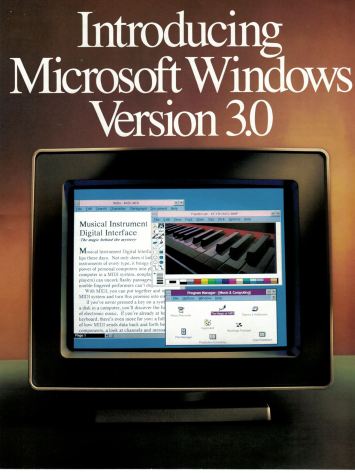
Introducing Microsoft Windows 3.0
From my mother’s papers

It was good enough. You could do any basic thing in Windows that you could do on the Mac. One could imagine that if the big Mac apps, like Framemaker, Photoshop, Quark Express, etc., made a Windows version, it could be viable. And it ran on cheaper hardware than a Mac.

Management was telling us that they were going to start work on porting FileMaker to Windows. To be fair, when Claris purchased FileMaker from Nashoba, there was already a skunkworks project to do just that (based on Windows 2). And one of my StyleWare colleagues had been working in what amounted to an internal lab to help that process out. The plan was to take the former Nashoba manager who had kept the project alive for years, the StyleWare guy, and hire a couple more programmers to make this real.

As the meeting ended, I went up to the assembled FileMaker managers. There was the aforementioned director, the CTO, my boss, and the Nashoba manager.

“I want to work on the Windows port.”

They looked stunned. They looked back and forth to each other.

I continued.

“I am not yet contributing features to FileMaker on the Mac; I am doing bug-fixing and tools work. While I have no Windows or DOS experience, I do have experience with low-level logic, compilers, and assembly. I would love the opportunity to get in on the ground floor on this project. I don’t see that opportunity on the Mac.”

My manager spoke up and said, “Let us talk about it. Give us a couple of days?”

They took me up on it. So, I got a Dell PC, and started work (I got the first 486 at Claris… It was sweet…) I won’t go into the details much, but I did manage to get in on the beta of Borland Pascal…

Things looked good.

Meanwhile, Claris was ramping up to go public. While Apple owned the company at this point, the plan all along was to spin it out so Apple would have a good stories when its developers claimed that Apple’s software was competing with theirs. And they were looking into doing that. The executives had a traveling road show that they were showing investors, and some people in suits would be shown around the building.


One Monday morning, that abruptly changed. We were called into an all-hands meeting, where it was announced that Apple was not going to spin us out. All outstanding Claris stock was going to be converted to cash, and the IPO was cancelled.

The FileMaker teams were then immediately called to another meeting. It was announced that we were cancelling plans for all Windows products that we had been working on (FileMaker, though first, was not the only one). I asked what was going to happen to the three of us who had been working on it, and was told to sit tight. Document everything we can; get all of our code checked in, but hold tight…

I started working on a resume for the first time since college. I also scheduled meetings with the directors in software engineering, and eventually, the VP of Engineering. All of the directors told me that hiring was frozen until things shook out with the Apple buyback.

It took several days to work through all of them. On Friday, when I met with the VP, he told me to “hold off on floating my resume”, and to “go home early today and enjoy the weekend”, and that “I think Monday will bring about some big changes.”

Huh.

I went to work on Monday, and we had yet another all FileMaker meeting. We were told that when the Claris management had told the Apple Board of Directors that all of the Windows products had been canned, the Board told them that they had missed the point, and that one of the reasons that they had spun us back in was so that Apple had something generating revenue from Windows. The long-term strategy had FileMaker Pro for Windows as a key piece.

Huh.

So. I got to keep my job. And we had positions open up. And we hired a team. And I eventually got a modest cash payout for my Claris stock options. And an Apple stock grant (which was worthless for 10+ years but would have been worth a boatload today). And they level-adjusted our salaries, which meant that most of us got a significant raise.

We shipped FileMaker Pro for Windows in October, 1992. It turned out to be a good thing, but it was sure scary there for a while.
FileMaker Pro 2.0 for Windows (1992)
Yeah, I know I posted this picture before, but I am posting it again just because I can.

Spartacus Software – 1989

When Claris bought StyleWare, they told us the plan was for us to do something for the Mac that was like AppleWorks GS for the Apple IIGS. All we had to do was finish AWGS, and we would then start that work.

It did not work out that way.

AppleWorks GS shipped in October, 1988. It was not a commercial success. First, it was still buggy and slow. Second, the sales of the Apple IIGS itself were disappointing. And third, Claris needed engineering help on other teams.

After AWGS shipped, we were assigned to various teams in the company. I was assigned to work on FileMaker, which had been purchased by Claris a while earlier. They had an existing engineering team, and I joined them for a while.

Others on the team were assigned to other projects within Claris, such as MacWrite, and MacDraw. Two of those engineers were not at all happy about this, and they decided to head out on their own. Their story is captured well in this writeup: History of ClarisWorks, so I won’t recap the story here.

Soon after they left, Claris decided to do one last push for AppleWorks GS. The goals was to fix bugs and performance, add one or two glaring missing features, update it to the new much more stable version of GS/OS, and to not ship anymore versions.

I was not terribly happy with having to work on the Apple IIGS again, but I really had no choice. Right about this time, one of the ClarisWorks guys approached me, just like he had approached me at Rice about working at StyleWare.

“We would really like you to work with us at Spartacus,” he said, over lunch at Dela Cruz Deli, in Sunnyvale.

“I am interested. Can you pay me?”

“We don’t have any cash. We are working without salary. My wife is making some money, so the rent on the house is mostly being paid. We hope to have a nice payout, and you would be part of that.”

“Do you have a Mac for me to use? I don’t own one.”

“No, you’d have to provide one.”

I gathered my thoughts.

“I was not one of the principal developers at StyleWare. While I got some payout for our royalties, I had to buy a car with that money. I am making less take home pay in California working for Claris than I was making in Houston working for StyleWare. I have student loans to deal with.

“I just can’t work without pay, even if I moved into the house with y’all. I’m going to have to pass.”

He was disappointed, but he understood. His partner also talked to me, but basically just asked me to confirm what I had already said.

There was no way I could have done it. It was at least 12 months before Claris officially bought ClarisWorks from Spartacus. I am happy for the guys who founded it; they did well. Quite well.

They also invited me to work on ClarisWorks after the sale, but they decided to have the team in the Portland, Oregon area, and I was not interested in living there, and by the time they asked, I was working on cool stuff on FileMaker.

I did not receive a big payout, but I am very happy with the rest of my career at Claris.

Project Scoresheet – 1989

AKA – My Third Career

I have other interests than computer science. I’ve already mentioned on this blog that I started college as a music major, and since I “quit” after one year, I’ve actually never stopped playing.

When I was a boy, when it was time for all of the other kids to start playing baseball, I was too sick. But I started watching the other kids; the Little League and Pony League park was across the street from my apartment complex. And, although the city we lived in was too small to have a major league team, and there wasn’t even a minor league team despite its size, I watched much as I could on TV. My parents wouldn’t let me stay up and watch on weeknights, so I missed Hank Aaron’s 715th home run. Sigh.

We moved to Houston in 1974, and I became a lifelong Houston Astros fan. I watched games, pored over the box scores in the newspaper, and participated in “Astros Buddies”, which got cheap seats for exciting games against San Diego and Montreal, and some swag.

When I got to high school, I really started to study the statistics. I created my own scoring system, and started tracking stats day-by-day. This is before personal computers, or, at least, before our family had personal computers, so I used a ledger book.

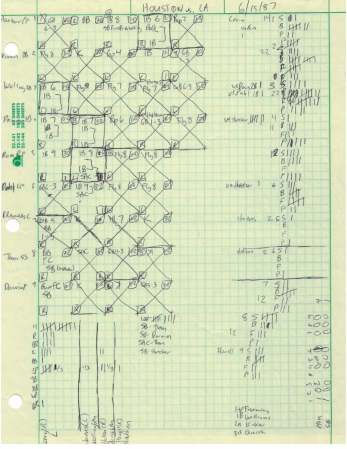
1987-06-15 Houston at Los Angeles
My home made scoring system showing the Astros batting lines, 6/15/87, Houston at Los Angeles

Right about that time, the Astros got good for a couple of years. They led their division most of the year in 1979, won their division in 1980, and went to the playoffs in that weird strike year of 1981.

And calling those games were Gene Elston, Dwayne Staats, and Larry Dierker. Dierker was a former pitcher from Houston, but, as detailed in Jim Bouton’s book, Ball Four, was a cerebral type.

I absolutely fell in love with the low-key style of that announcing crew. Dierker was also ahead of his time – he talked about the importance of on-base percentage, and how the Astrodome distorted players numbers such that you had to make adjustments when comparing them to the rest of the league.

When I got to college, a friend of my father’s gave Dad a book, which he glanced at, and decided that I would enjoy it more that he would, so he gave it to me. It was the 1985 Bill James Baseball Abstract. These books, published by a real publisher from 1982-1988, were seminal works in the advanced stats and metrics movement that has taken over the leagues now, 30 years later. James talked about how awesome Jose Cruz was, how awful Omar Moreno was, the fact that Wrigley Field and Fenway Park favored the hitter, and the Oakland Colisseum, Dodger Stadium, and the Astrodome favored the pitcher. This edition had his first study showing a direct correlation between minor league performance and major league performance, after adjusting for difficulty and ballpark effects.

I ate it up.

This story centers around something in the appendices, however. James was frustrated; he wanted access to the daily play-by-play data that Major League Baseball kept, and had kept for decades. The Elias Bureau is the corporate entity in charge of that data. James offered them as much money as he could to get those accounts, but MLB and Elias would not (and still do not) sell them, no matter what.

So James went open-source. He put together a volunteer organization called Project Scoresheet. This organization would split up the games for all 26 teams existing at the time, and would score them in a system that was easily adapted for computer consumption. He started this call in the 1983 Abstract, and Project Scoresheet started scoring games for the 1984 season.

In the back of the 1985 Abstract, there was a chapter on Project Scoresheet and how one could volunteer. I was too busy for the 1986-1987 seasons, but after I got my act together, I volunteered for the 1988 season.

I did a few games after reading the PS system. However, the Astros regional coordinator decided to host a game at the Astrodome for all of the Houston area volunteers. There were 14 of us there, training for Project Scoresheet.

1988-06-01 St. Louis at Houston.jpg
The St. Louis side of my Project Scoresheet scoring of St. Louis vs. Houston, 6/1/88.

I had a blast. I scored 12 Astros games in 1988, but had to stop after Claris bought StyleWare, and I moved to the Bay Area.

Project Scoresheet wrote a book of baseball stats after the 1986 and 1987 seasons, called “Bill James Presents The Great American Baseball Stat Book”, and of course, I had copies of both.

1988 GABSB Cover

Some time around December 1988 or January, 1989, I got a phone call from the regional director for Project Scoresheet in Houston. He had been asked to write the Houston chapter introduction and the player summaries for the 1988 book, but he needed help. He asked if I would. I said, “Yes”.

I wrote player summaries for all of the Astros, including one about Nolan Ryan. The gist was that Ryan’s 1988, while not as great as his 1987, was almost that great, especially if one threw his two worst starts out of the mix. I was quite upset that Houston had not signed him again…

So, I got all of that stuff written and sent in. Sherri Nichols was the overall editor for this year, and I was hoping that I would be a published baseball writer.

Unfortunately, Project Scoresheet was no more before the book was published. Stats, Inc opened up shop, and decided to sell the data that Project Scoresheet had collected with volunteer labor to the media and to major league teams. This did not sit well with most of the PS crowd, and the organization fell apart. Some of them ended up working for Stats, Inc., but many, many others hung around on the Internet news group, rec.sport.baseball, which is where most of the advanced work for sabermetrics was conducted until the World Wide Web took over. There is a direct lineage from Bill James, through Project Scoresheet, to rec.sport.baseball, to Baseball Prospectus (and other annuals like it), to Moneyball, to the modern front office.

I continued sending in scoresheets to Project Scoresheet for the next few years, until the fax machine stopped answering. A few years later, David Smith, Sherri Nichols, and a few others got the Project Scoresheet data and started a website called Retrosheet, whose purpose was to create an archive of every game ever played in the major leagues. They have play-by-play data now going back decades. It is the vision of Project Scoresheet realized, and it uses the same scoring system. If you download the data from 1988-1992, I am the official scorer of a handful of games.

This was as close as I got to being on the inside of this world for a very long time.

Nintendo – 1989

My phone at work rang. (Remember when people had phones at their desk?)

“Claris, this is ___.”

“Hello. My name is John Smith. I represent a video game company here in town. We are looking for software developers for our next generation gaming console.”

Blink. “Um, OK.”

“I understand you have experience with the Western Digital 65C816 processor?”

“Yes, I do.”

“That’s great! We are looking for experienced developers on this processor to work on our exciting new game console and games for it!

“Do you play video games?” he asked, hopefully.

“Well, I don’t play video games that much, and when I do, it’s on the Apple II or the Mac.”

He said some non-committal things, and then asked the golden question:

“Would you be interested in interviewing for a position on our Santa Clara-based development team?”

“I would have to write 65816 assembly?”, I asked.

“Yes, that’s why I am talking with you.”

I paused and planned out what I was going to say.

“I have been promised a position at my current company working on the Mac once we wrap up our current project. Once that happens, I hope to never 1. work in assembly again, and 2. work on the 65816.

“So, I am afraid I’ll have to pass.”

He sighed. “OK, do you know anybody else who might be interested.”

I wouldn’t subject that to any of the other StyleWare people, or any of the Apple II people I had met at Apple since I moved to California.

“Afraid not.”

He game me his number, and said goodbye.

Ten minutes later, a phone near me rang, and one of my teammates answered. It was the same guy. Turns out, the guy was going down the list of names in the About Box, calling the Claris switchboard, and asking for each of them in turn.

Found out later that the machine in question was the Super Nintendo, and he must have been working for Nintendo, since when he called, the machine hadn’t shipped yet.


Word Perfect – 1988

WPpd

I had been permanent at StyleWare for a few months, and we went to AppleFest, a trade show in Boston dedicated to the Apple II. We had found out a few days before we left that we had been acquired by Claris Corporation, but we were not allowed to talk about it.

The show ran Thursday through Sunday. Sunday afternoon about 3:00, I was running the booth. The show closed at 5:00, and was already winding down. The booth next to us had been playing Bruce Springsteen’s “Pink Cadillac” over and over and over again (evidently, they were a sound editing company, and were hyping the S in GS, which stood for Graphics and Sound).

So I was bored and annoyed and tired. A man in a suit nicer than mine came up to me. He was middle-aged, and cheerful. He had me show my demo.

He then said, “What’s your name?”

I told him. Then he continued,

“I’m Tim Johnson, and I work for WordPerfect.”

An aside: GSWorks, in the About… menu, displayed a dialog box with all of the developers’ names in it. Our president had managed to score a copy of WordPerfect IIGS. There were no developer names in their About Box. He did find the names, however. Programs on the IIGS were divided into segments for reasons that are too arcane for this blog. Our segments had names like “WP” (Word Processor) or “SS” (Spreadsheet), other utilitarian names like “DRIVER”. The developers for WordPerfect had hidden their names with segment names “DAVE”, “JOHN”, and “RAHUL”. Nice company, that.

I looked at him in the eye. “Oh, OK. Aren’t y’all doing a WYSIWYG version of that for the GS?”

“Yes, we are. Would you like to join us and work on it?”

Blink. Wait a minute…

“You are recruiting me for a job? Here on the show floor?”

“Well, frankly, yes!”

I paused. “Where are you located?”

“Provo, Utah”

It was hard to have a poker face. That is not a place I had ever considered living. I still am not interested in living there 30 years later.

“How many on your team?” I asked, while I tried to figure out how to say “No.”

“We have 3 now, but we just lost two, and are hoping to replace them soon. Which is why I am talking to you,” he said, smiling, while putting his hands in his pockets.

“And what is your position?”

“I am Director of Graphical Products,” he said, proudly.

I paused, trying to look thoughtful.

I said, “Well, I am hoping that after the IIGS runs its course, I can work on the Mac. I don’t really enjoy programming for the Apple II. I don’t think I want to move to Provo to work on the Apple IIGS.”

He whipped a card out of his pocket.

“Well, if you change your mind, call me and let me know.”

“OK, and thank you.”

Gotta admit; that took some guts. He must have been scouting for a while, waiting until I was alone in the booth.

Oh, and by 5:00, everybody had returned to the booth. The show closed (they announced it on the PA), and the guy with the stereo turned it up louder! The four of us programmers went over and asked the guy to turn it off. He said no! It’s a party! One of my buddies actually threatened physical violence. The guy thought it was a joke, but we all took as threatening stances as four sun-starved, shaggy, nerdy programmers could possibly take, and he finally backed down and turned the music off. Everybody around us cheered.

I still can’t listen to that song.